
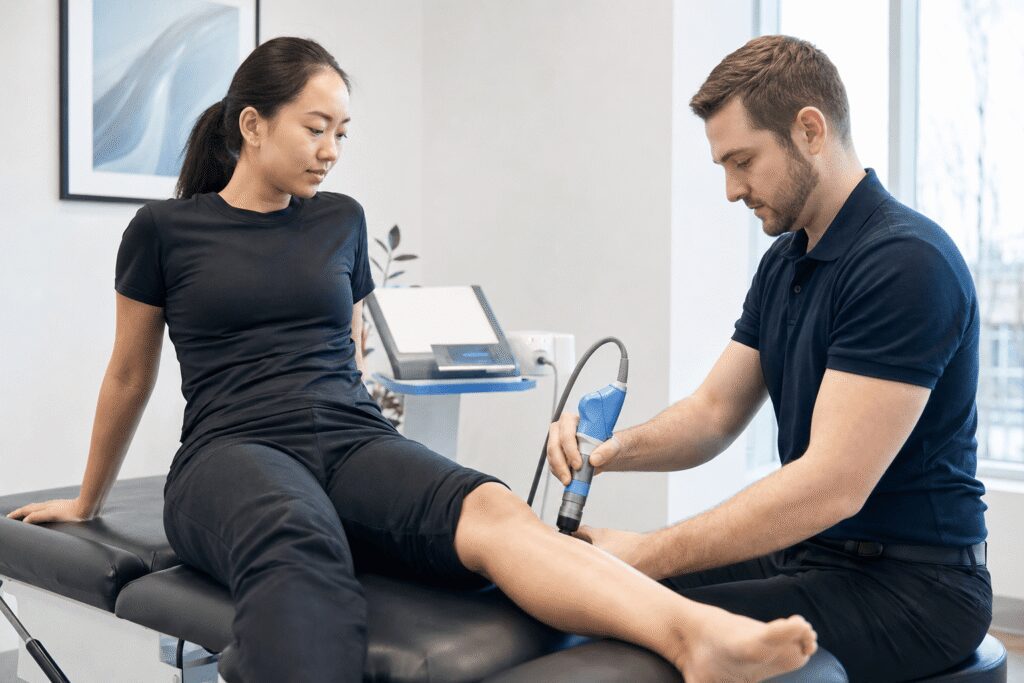
If you’ve been dealing with chronic tendonitis, plantar fasciitis, or stubborn soft tissue pain that hasn’t responded to conventional treatment, you’ve likely encountered the term shockwave therapy. Also called extracorporeal shockwave therapy (ESWT), this non-invasive treatment uses high-energy acoustic waves to stimulate healing in injured tissues. Unlike surgery or injections, shockwave therapy works by triggering your body’s natural repair processes, promoting new blood vessel formation and breaking down calcified deposits that contribute to pain.
This guide explains exactly what shockwave therapy is, how it works, which conditions respond best, and what to expect during treatment. We’ll also cover benefits and potential side effects, costs in Ontario including insurance coverage, and how physiotherapists assess whether you’re a good candidate for this treatment approach.
Quick Answer
Shockwave therapy delivers high-energy acoustic waves to injured tissues, triggering cellular repair, increasing blood flow, and breaking down scar tissue. It’s primarily used to treat chronic tendonitis, plantar fasciitis, and calcific deposits when other conservative treatments haven’t provided lasting relief. Treatment typically costs $75-$150 per session in Ontario, with most patients requiring 3-6 sessions spaced weekly.
What Is Shockwave Therapy?
Shockwave therapy is a non-invasive treatment modality that uses acoustic waves to treat musculoskeletal conditions. The technology was originally developed in the 1980s to break up kidney stones, but researchers quickly discovered its effectiveness for treating chronic soft tissue injuries.
The treatment works by delivering controlled mechanical energy to injured tissues. These acoustic waves create micro-trauma at the cellular level, which jumpstarts your body’s healing response in tissues that have stopped responding to conventional treatment.
At Greatlife Physio in Richmond Hill, our registered physiotherapists use shockwave therapy as part of comprehensive treatment plans for patients with chronic tendonitis, plantar fasciitis, and other stubborn musculoskeletal conditions. The treatment typically requires 3-6 sessions spaced one to two weeks apart.
Key Takeaways
- Expect 3-6 treatment sessions spaced weekly for most chronic conditions
- Choose this therapy after conservative treatments haven’t resolved pain
- Verify your insurance coverage as many extended plans include shockwave
- Avoid treatment if pregnant or over areas with active infection
- Combine with exercise therapy for optimal long-term healing outcomes
How Does Shockwave Therapy Work?
Understanding the biological mechanism behind shockwave therapy helps explain why it’s effective for conditions that resist other treatments. The acoustic waves create several distinct effects at the cellular level.
First, the mechanical energy disrupts calcified deposits and scar tissue that have accumulated in chronically injured tendons. This is particularly important for conditions like calcific tendonitis of the rotator cuff, where calcium deposits cause significant pain and restrict movement.
Second, the treatment triggers a controlled inflammatory response. While inflammation gets a bad reputation, acute inflammation is actually essential for healing. The shockwaves create micro-cavitation (tiny bubbles in tissue fluid) that stimulates your body to send healing factors to the area, including growth factors, stem cells, and increased blood supply.
Third, shockwave therapy appears to affect pain perception by overstimulating nerve endings through the gate control theory of pain. Most people notice gradual improvement starting 6 to 8 weeks after beginning treatment, with continued gains for up to 12 weeks following the final session.
Types of Shockwave Therapy: Radial vs Focused
There are two main types: radial and focused. Understanding the difference helps explain why your physiotherapist might recommend one over the other for your specific condition.
Radial Shockwave Therapy (R-SWT)
Radial shockwave therapy uses a pneumatic device that generates acoustic waves at the applicator tip. These waves spread outward in a radial pattern, affecting a larger treatment area but with less tissue penetration (typically 3-4 cm deep). R-SWT is ideal for superficial conditions like plantar fasciitis, tennis elbow, and Achilles tendonopathy. It’s also generally more comfortable than focused shockwave therapy.
Focused Shockwave Therapy (F-SWT)
Focused shockwave therapy concentrates acoustic energy at a specific depth within the tissue, typically reaching 6-12 cm below the skin surface. The energy converges at a focal point, delivering higher intensity to a precise location. F-SWT is preferred for deeper conditions like calcific tendonitis of the rotator cuff or deep hip tendon issues. The concentrated energy is more effective at breaking up calcified deposits but is typically more uncomfortable.
At Greatlife Physio, our therapists conduct thorough assessments to determine which type of shockwave therapy best matches your condition, considering tissue depth, the extent of calcification, your pain tolerance, and how the treatment integrates with other components of your rehabilitation program.
Ready to start your recovery?
Our registered physiotherapists in Richmond Hill offer personalized treatment plans with direct billing. WSIB and MVA accepted.
Conditions Treated with Shockwave Therapy
Shockwave therapy has the strongest evidence base for chronic tendinopathies that haven’t responded to at least 3 months of conservative treatment. Success rates vary by condition, and setting realistic expectations is crucial.
| Condition | Success Rate | Evidence Level |
|---|---|---|
| Plantar Fasciitis | 60-80% | Level 1 (Randomized controlled trials) |
| Achilles Tendonopathy | 65-75% | Level 2 (High quality studies) |
| Tennis Elbow | 60-70% | Level 2-3 (Mixed evidence) |
| Calcific Rotator Cuff Tendonitis | 60-90% | Level 2 (Controlled trials) |
| Patellar Tendonitis | 50-70% | Level 3-4 (Emerging evidence) |
Conditions that typically don’t respond well include acute injuries (less than 6 weeks old), nerve entrapment syndromes, and pain primarily driven by joint arthritis rather than soft tissue dysfunction.
What to Expect During Your Shockwave Treatment Session
Knowing what happens during a typical treatment session helps reduce anxiety and ensures you’re prepared for the experience.
Preparation: You’ll be positioned comfortably with the treatment area exposed. The physiotherapist will apply ultrasound gel and palpate the area to identify the exact treatment location.
During Treatment: The physiotherapist will begin at a lower intensity and gradually increase as tolerated. Most people describe the sensation as a deep tapping or pulsing feeling that can range from mildly uncomfortable to moderately painful. The discomfort stops immediately when the device is lifted.
Treatment Duration: A typical session delivers 2000-4000 shockwave pulses to the affected area, which takes approximately 5-10 minutes.
Post-Treatment: After treatment, the area may feel tender for several hours. Applying ice for 10-15 minutes can help manage post-treatment soreness. You should avoid intense exercise for 24-48 hours but can continue with normal daily activities.
Follow-Up Sessions: Subsequent sessions are typically scheduled 5-7 days apart. This timing allows the initial healing response to develop before delivering the next treatment stimulus. The physiotherapist will assess your progress at each visit and may adjust treatment parameters based on your response.
In our Richmond Hill clinic, we emphasize that shockwave therapy works best as part of a comprehensive approach. Between sessions, patients typically continue with specific exercises, activity modifications, and sometimes complementary treatments like massage therapy to address muscle tension that contributes to tendon overload.
We often combine radial shockwave with targeted exercises that address biomechanical factors causing your tendonitis. Treating symptoms without fixing movement patterns typically leads to recurrence within months.
Benefits and Side Effects of Shockwave Therapy
Like any medical treatment, shockwave therapy comes with both advantages and potential drawbacks. Understanding both helps you make an informed decision about whether to pursue this option.
Key Benefits and Advantages
The primary benefit is addressing the root cause of chronic tendonitis rather than just managing symptoms. Unlike anti-inflammatory medications or cortisone injections that provide temporary relief, shockwave therapy attempts to restore normal tissue structure and function.
The treatment is non-invasive with no needles, no incisions, and no recovery time beyond temporary soreness. Most patients return to normal activities immediately after treatment. Shockwave therapy avoids the potential complications of surgery and the tissue weakening effects associated with repeated cortisone injections.
The treatment requires minimal time commitment. Sessions typically last 5-10 minutes, and most conditions require 3-6 treatments total. Many patients experience long-lasting improvement, with studies showing sustained benefits at 6-12 month follow-ups when combined with appropriate exercise rehabilitation.
Common Side Effects
The most common side effect is temporary pain and discomfort during and immediately after treatment. Many patients describe a deep aching sensation during the session, which typically subsides within hours. Some bruising and swelling in the treatment area is normal and usually resolves within a few days.
About 10-15% of patients experience a temporary increase in their baseline pain for 1-3 days after treatment. This is actually considered a positive sign that the tissue is responding. Rare complications include skin redness, numbness, or hematoma formation. These side effects are generally mild and self-limiting.
Contraindications and Who Should Avoid Treatment
Absolute contraindications include pregnancy, active infection in the treatment area, blood clotting disorders, and use of anticoagulant medications. Treatment over tumors, fractures, or growth plates in children is also contraindicated.
Relative contraindications that require careful assessment include diabetes with peripheral neuropathy, peripheral vascular disease, severe osteoporosis, and certain neurological conditions. Patients with pacemakers should avoid treatment near the device. Your physiotherapist will conduct thorough screening during your initial assessment to identify any contraindications before beginning treatment.
Shockwave Therapy Costs and Insurance Coverage in Ontario
Understanding the financial aspects of shockwave therapy helps you plan for treatment and maximize available coverage options.
Session Costs and Treatment Packages
Shockwave therapy is not covered by OHIP (Ontario’s public health insurance). In Ontario, individual shockwave therapy sessions typically cost between $75 and $150 per session, depending on the clinic, treatment complexity, and whether radial or focused shockwave is used. A complete treatment course of 3-6 sessions generally ranges from $225 to $900 total.
Some clinics offer package pricing for multiple sessions, which can reduce the per-session cost by 10-15%. Ask about this option during your initial consultation. At Greatlife Physio, we provide transparent pricing and discuss all costs during your assessment so there are no surprises.
Extended Health Insurance Coverage
Many extended health insurance plans include coverage for shockwave therapy when delivered by a registered physiotherapist. Coverage limits vary by plan but typically range from $50-$100 per session, applied toward your annual physiotherapy maximum (commonly $500-$2000 per year).
Greatlife Physio offers direct billing to most major insurance providers, which means you won’t need to pay upfront and wait for reimbursement. We also accept WSIB claims for workplace injuries and MVA (motor vehicle accident) claims, which may cover shockwave therapy when medically indicated as part of your rehabilitation.
Check your specific coverage by contacting your insurance provider before beginning treatment. Ask about your annual physiotherapy maximum, per-session limits, and whether shockwave therapy specifically is a covered modality under your plan.
Tax Deductions and Payment Options
Keep your receipts regardless of insurance coverage. Physiotherapy expenses, including shockwave therapy, qualify as medical expense tax deductions on your Canadian income tax return when they exceed 3% of your net income. These deductions can provide meaningful tax relief, especially if you have multiple family members with healthcare expenses.
Frequently Asked Questions
Getting Started with Shockwave Therapy at Greatlife Physio
Shockwave therapy represents an effective option for chronic soft tissue conditions that haven’t responded to first-line treatments. The evidence is strongest for plantar fasciitis, Achilles tendonopathy, and calcific rotator cuff tendonitis, with success rates ranging from 60-80% for properly selected candidates.
Success depends on proper patient selection, appropriate technique selection (radial versus focused), and integration with exercise therapy and activity modification. It’s not a standalone solution but rather one component of comprehensive rehabilitation that addresses both symptoms and underlying biomechanical factors.
If you’re dealing with chronic tendonitis or persistent soft tissue pain, a thorough assessment by an experienced physiotherapist can determine whether shockwave therapy is appropriate for your condition. Our team at Greatlife Physio in Richmond Hill combines clinical expertise in shockwave therapy with comprehensive physiotherapy treatments to optimize your recovery outcomes.
Ready to explore whether shockwave therapy is right for your condition? Book an assessment with our physiotherapy team in Richmond Hill. We’ll conduct a thorough evaluation, discuss all appropriate treatment options including costs and coverage, and create a personalized plan to help you return to pain-free activity. Call us at (647) 948-4202 or book online today.
