
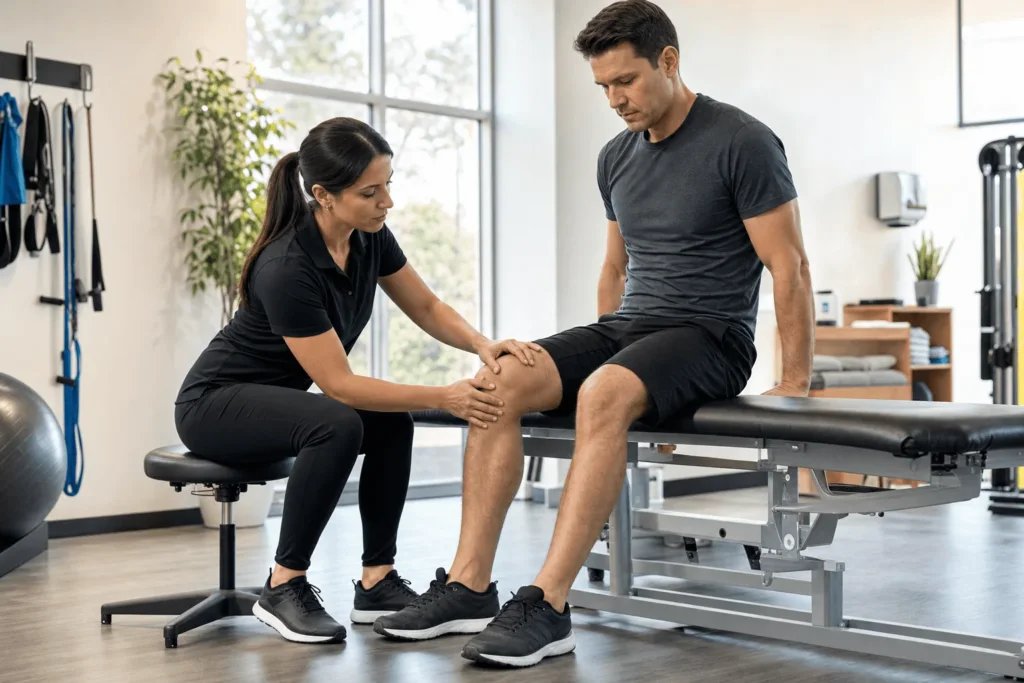
Knee pain disrupts daily activities, from climbing stairs to walking short distances. Physiotherapy for knee pain offers targeted treatment that addresses the root cause of your discomfort, not just temporary symptom relief. Whether you’re dealing with arthritis, a sports injury, or chronic pain, understanding what causes your knee pain and how physiotherapy can help is the first step toward lasting recovery.
At Greatlife Physio in Richmond Hill, Ontario, our registered physiotherapists create personalized treatment plans that combine manual therapy, targeted exercises, and pain management techniques. We work with patients recovering from acute injuries, managing chronic conditions, and rebuilding strength after surgery.
Quick Answer
Physiotherapy treats knee pain through targeted exercises, manual therapy, and pain relief modalities that strengthen surrounding muscles, improve joint mobility, and address the underlying cause rather than masking symptoms.
Common Causes of Knee Pain: What’s Behind Your Discomfort
Knee pain stems from various sources. Some develop gradually through repetitive stress or wear, while others happen suddenly from trauma or overuse.
Understanding what’s causing your knee pain helps your physiotherapist design the most effective treatment approach. The knee is a complex joint where bones, cartilage, ligaments, and tendons work together. When any component becomes damaged or inflamed, pain results.
Degenerative Conditions (Osteoarthritis, Cartilage Wear)
Osteoarthritis is the leading cause of chronic knee pain, particularly in adults over 50. The protective cartilage that cushions your knee joint gradually breaks down, causing bone-on-bone friction, stiffness, and inflammation.
Patellofemoral pain syndrome, often called runner’s knee, affects the cartilage under your kneecap. This condition commonly develops in younger, active individuals who participate in running, jumping, or cycling activities that involve repetitive knee bending.
Acute Injuries (ACL Tears, Meniscus Tears, Patellar Tendinitis)
Anterior cruciate ligament (ACL) injuries typically happen during sports that involve sudden stops, direction changes, or awkward landings. You might hear a pop and feel immediate instability in your knee.
Meniscus tears often occur when twisting or rotating your knee while bearing weight. When torn, you may experience pain, swelling, and a catching or locking sensation.
Patellar tendinitis, also called jumper’s knee, results from overuse that creates small tears in the tendon connecting your kneecap to your shinbone. Basketball players, volleyball players, and runners commonly develop this condition.
Key Takeaways
- Identify your specific knee pain cause before starting any treatment protocol
- Seek professional assessment if pain persists beyond 72 hours or limits mobility
- Expect 6-12 weeks recovery for most knee conditions with consistent physiotherapy
- Combine in-clinic treatments with daily home exercises for optimal healing results
- Ask about direct billing options to access care without upfront payment barriers
When to See a Physiotherapist for Knee Pain (Warning Signs You Shouldn’t Ignore)
Not all knee pain requires immediate professional treatment. Minor discomfort that resolves within a few days often responds well to rest, ice, and over-the-counter pain relief. But certain warning signs indicate you need expert assessment sooner rather than later.
When to See a Physiotherapist Soon
Schedule a physiotherapy appointment if you experience:
- Knee pain persisting beyond 72 hours despite home care
- Increasing difficulty with stairs, walking, or daily activities
- Swelling that develops gradually over several days
- Stiffness that limits your range of motion
- Pain that worsens with specific movements or activities
- Knee instability or feeling that your knee might give out during weight-bearing
When to Seek Emergency Medical Attention
Go to the emergency department or call for immediate medical help if you have:
- Sudden severe pain with visible deformity or misalignment of the knee
- Complete inability to bear any weight on the leg
- Massive swelling within 1-2 hours of injury
- Fever above 38°C (100.4°F) combined with knee redness, warmth, or swelling (signs of possible infection)
- Numbness, tingling, or color changes in your foot or lower leg
- Knee pain following significant trauma like a car accident or high-impact fall
Age-Specific Considerations for Knee Pain
Your age significantly influences both the likely cause of knee pain and treatment approach.
Athletes and active adults under 40 typically experience acute injuries like ACL tears, meniscus damage, or patellar tendinitis from sports and high-impact activities. Treatment emphasizes aggressive strengthening and sport-specific rehabilitation to restore peak performance.
Office workers aged 30-50 commonly develop patellofemoral pain syndrome from prolonged sitting, weak hip muscles, and poor movement patterns. Treatment focuses on posture correction, workstation ergonomics, hip strengthening, and movement retraining.
Seniors over 60 frequently face osteoarthritis as cartilage naturally wears down with age. However, how physiotherapy helps arthritis demonstrates that conservative care slows progression, maintains independence, and reduces fall risk through balance training and controlled strengthening.
Patients who begin treatment within the first two weeks of knee pain typically need 30-40% fewer total sessions compared to those who wait several months before seeking care.
Your First Physiotherapy Assessment: What to Expect
Your initial physiotherapy appointment establishes the foundation for your entire treatment plan. This comprehensive evaluation typically lasts 45-60 minutes.
Come prepared to discuss your medical history, current symptoms, and activity limitations. Wear comfortable clothing that allows your physiotherapist to observe and assess your knee movement, such as shorts or loose-fitting pants.
The assessment begins with a detailed conversation about your pain: when it started, what makes it better or worse, and how it affects your daily life. Your physiotherapist will ask about previous injuries, surgeries, and other health conditions that might influence treatment.
Physical examination includes observation of how you walk, stand, and move. Your therapist will palpate areas around your knee to identify tender spots and swelling. Range of motion testing measures how far you can bend and straighten your knee. Strength assessment evaluates the muscles that support your knee, particularly your quadriceps, hamstrings, and hip muscles. Special tests help identify specific structures causing your pain.
Based on assessment findings, your physiotherapist will explain their diagnosis, discuss treatment options, and create a personalized plan. This includes recommended session frequency, expected treatment duration, and home exercise responsibilities.
For Ontario residents, direct billing availability makes starting treatment more accessible. WSIB and MVA coverage is accepted for workplace injuries and motor vehicle accidents.
Ready to start your recovery?
Our registered physiotherapists in Richmond Hill offer personalized treatment plans with direct billing. WSIB and MVA accepted.
How Physiotherapy Treats Knee Pain: A Comprehensive Approach
Effective knee pain physiotherapy treatment combines multiple techniques tailored to your specific condition, goals, and recovery stage. This multi-modal approach addresses pain, improves function, and prevents recurrence.
Pain Management and Therapeutic Modalities
Reducing pain and inflammation creates the foundation for active rehabilitation. Manual therapy includes hands-on techniques that mobilize your knee joint, release tight surrounding muscles, and improve tissue flexibility.
For patients requiring additional soft tissue support, our therapists can coordinate with massage therapy services within the same Richmond Hill facility for targeted treatment of quadriceps, hamstrings, and calf muscles that contribute to knee pain.
Electrotherapy for pain relief delivers controlled electrical stimulation that blocks pain signals and reduces inflammation. Ultrasound therapy uses sound waves to generate deep tissue heating, which increases blood circulation and accelerates healing in tendons and ligaments.
Strengthening and Flexibility Exercise Programs
Exercise forms the core of successful knee rehabilitation. Your personalized program progresses through specific phases as your knee heals.
Quadriceps strengthening is critical because these thigh muscles control knee movement and absorb shock during walking and running. Hamstring exercises balance the forces around your knee. Hip strengthening improves knee alignment and stress distribution. Weak hip abductors allow your knee to collapse inward during movement, creating excessive wear on cartilage and ligaments.
Balance and proprioception training improves your body’s awareness of knee position and movement. This reduces reinjury risk and builds confidence during activities. Functional training incorporates movements specific to your daily activities or sports.
Progressive loading is essential. Exercises start with minimal resistance and gradually increase as your strength improves. Advanced techniques like dry needling treatment may complement exercise programs by releasing trigger points in muscles that limit proper activation during rehabilitation.
Exercise compliance determines outcomes more than any other factor. Patients who complete their home program five days per week recover twice as fast as those doing exercises only twice weekly.
Home-Based Strategies and Self-Management Between Sessions
Your in-clinic physiotherapy sessions matter, but what you do between appointments determines your overall success. Consistent home care accelerates healing and prevents setbacks.
Follow the RICE protocol during the first 48-72 hours after acute injury or pain flare-ups: Rest (avoid activities that worsen pain), Ice (apply for 15-20 minutes every 2-3 hours), Compression (use an elastic bandage to reduce swelling), Elevation (raise your leg above heart level when sitting or lying down).
Complete your prescribed home exercises daily. These are essential components of your treatment plan. Set a specific time each day for your exercises to build a consistent routine. Monitor your pain levels during and after exercises. Mild discomfort during exercise is normal and expected. Sharp pain or significant increases in swelling indicate you’re pushing too hard.
Modify activities that aggravate your knee pain. This doesn’t mean complete rest, which often delays recovery. Instead, find alternative activities that maintain fitness without stressing your knee. For example, if running causes pain, try cycling or swimming.
Use supportive devices appropriately. Knee braces can provide stability during activities, but shouldn’t become permanent crutches that prevent muscle strengthening. Maintain healthy body weight. Every pound of excess weight adds roughly four pounds of pressure on your knees during walking. Choose appropriate footwear with adequate support to prevent altered walking mechanics.
Track your progress by noting pain levels, completed exercises, and functional improvements. Communicate with your physiotherapy team about new symptoms or concerns promptly rather than waiting for your next scheduled appointment.
Recovery Timeline: What to Expect for Different Knee Conditions
Recovery timelines vary significantly based on your specific condition, injury severity, age, overall health, and treatment adherence. Understanding realistic expectations helps you stay motivated and avoid frustration.
| Condition | Typical Recovery Timeline | Key Milestones |
|---|---|---|
| Minor sprains/strains | 2-4 weeks | Week 1: Pain reduction; Week 2-3: Walking normalized; Week 4: Resume daily activities |
| Patellar tendinitis | 6-12 weeks | Week 2-3: Pain reduction; Week 6: Improved stairs; Week 12: Return to jumping activities |
| Meniscus tears (conservative) | 6-12 weeks | Week 2-4: Reduced catching; Week 6-8: Full range of motion; Week 12: Sport-specific training |
| Osteoarthritis management | Ongoing (symptoms improve 4-8 weeks) | Week 4: Reduced stiffness; Week 8: Increased walking tolerance; Ongoing: Maintained function |
| Post-ACL reconstruction | 6-9 months to full sport return | Month 3: Full extension, walking normalized; Month 6: Running progression; Month 9: Return to play |
| Patellofemoral pain syndrome | 6-12 weeks | Week 3-4: Easier stairs; Week 8: Extended walking; Week 12: Return to running gradually |
Understanding Recovery Phases
Early recovery phase (weeks 1-2) focuses on pain and swelling reduction. Intermediate recovery phase (weeks 3-6) emphasizes restoring range of motion and beginning strengthening exercises. Advanced recovery phase (weeks 6-12+) progresses to functional strengthening and activity-specific training.
Return to sport or high-demand activities requires additional time beyond pain resolution. Your knee needs sufficient strength, stability, and movement control to handle these stresses safely.
Condition-Specific Recovery Expectations
ACL tears treated with surgery typically require 6-9 months before returning to competitive sports. Athletes can expect to walk without crutches by 4-6 weeks, begin running at 3-4 months, and progress to sport-specific drills at 5-6 months. Full clearance depends on strength tests showing 90% symmetry between legs.
Meniscus tears treated conservatively generally improve within 6-12 weeks. Patients notice reduced catching and locking by week 2-4, achieve full range of motion by week 6-8, and return to sports by week 12. Surgical repairs require 3-6 months for complete healing.
Patellar tendinitis responds to physiotherapy within 6-12 weeks for most patients. Pain during daily activities decreases by week 2-3, stair climbing becomes easier by week 6, and return to jumping or running sports occurs around week 12. Chronic cases may need longer treatment.
Osteoarthritis management is ongoing, but most patients experience significant symptom improvement within 4-8 weeks. Morning stiffness reduces by week 4, walking tolerance increases by week 8, and functional improvements continue with consistent exercise maintenance.
Setbacks happen occasionally and don’t mean treatment failure. A temporary increase in pain after increased activity is normal. Communicate with your physiotherapist to adjust your program appropriately.
Frequently Asked Questions
Knee pain doesn’t have to limit your life. Evidence-based physiotherapy treatment addresses the root cause of your discomfort, rebuilds strength and stability, and provides lasting relief without relying solely on medication or surgery.
Whether you’re dealing with arthritis, recovering from injury, or managing chronic pain, professional physiotherapy creates a clear path forward. The registered physiotherapists at Greatlife Physio in Richmond Hill develop personalized treatment plans that fit your specific condition, goals, and lifestyle. With direct billing available and WSIB/MVA coverage accepted, accessing the care you need is straightforward. Call (647) 948-4202 or book your appointment today to start your recovery journey.
